The useful bit, first
- Plan the composition on the floor before making any marks or attaching hardware.
- Choose the hanging method for the exact wall surface, framed weight, and product restrictions.
- Tabletop displays can provide character when wall mounting is unsuitable or unapproved.
A room can feel personal with one carefully placed photograph or print. You do not have to fill an entire wall, and you do not have to start with a large gallery arrangement. In a rental, the strongest art display is usually the one that combines a clear composition with a hanging method you have actually checked.
Begin with the pieces you care about. Then decide where they will be seen, what will support them, and how they will come down. The wall should not become an experimental surface simply because the hardware is labeled removable.
Choose the place before the frame size
Stand at the doorway and notice where your eye naturally rests. An empty wall beside the dining table or over a low cabinet may be a better focal point than the narrow strip behind an open door. Consider what is already competing for attention: shelves, a television, busy curtains, or an exposed clothing rail.
Next, look from the place where you will view the art most often. A print beside a reading chair needs to feel comfortable from the chair, not only from a standing position. There is no single hanging height that solves every room. Start with the usual viewing position and check the relationship to nearby furniture.
A piece does not have to span most of a wall. A small print with generous empty space around it can feel deliberate. If it looks lost, try a different position or a wider mat before assuming you need several additional pictures.
Work out what you are allowed to attach
Check the lease and get approval for the proposed method where required. Ask a specific question about picture hanging rather than a general question about decorating. The owner may allow a small conventional fixing, accept particular adhesive products, or prefer no wall attachment at all.
Inspect the wall for weak paint, rough texture, damp areas, or wallpaper. Do not attach hardware to an obviously failing finish. A removable product still relies on the surface beneath it. Covering a damaged patch with art does not resolve a repair issue.
If a drilled fixing is approved, use the correct installation for the wall and item through a suitable installer where needed. Do not guess whether plasterboard, masonry, or an unknown wall can support a particular load. The absence of visible damage is not evidence that an improvised mounting method is sound.
Weigh the finished piece, not just the print
Include the frame, glazing, backing, and any attached hardware in the weight. A print on paper may be light while its frame is substantial. Check the product’s size restrictions as well as its weight rating; both can matter.
Match the hanging product to its intended use and follow the prescribed arrangement. Command’s guidance says that extra strips do not automatically increase the allowed capacity. A group of general-purpose hooks is not necessarily an appropriate support system for a frame.
Read the exclusions too. Command’s picture hanging strip instructions, for example, say not to use them over beds, on wallpaper, or for valuable or irreplaceable items. Use the instructions on your exact product, including the version sold in your location. Those details are more useful than a social media photo showing a superficially similar wall.
Lay out a group before putting it on the wall
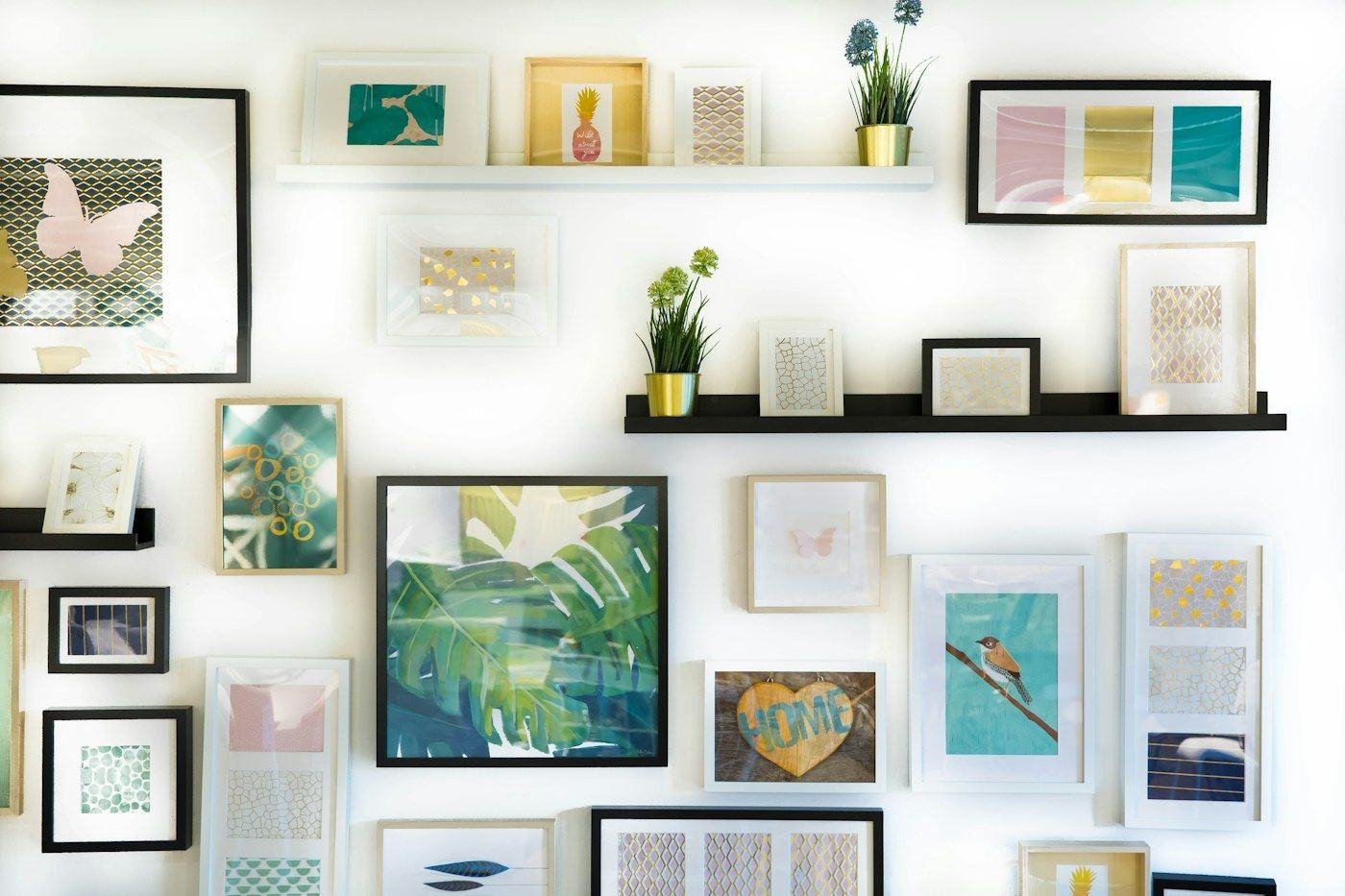
Arrange the framed pieces on the floor or on a large table. Start with the largest or most visually important item, then place the others around it. Photograph two or three arrangements so you can compare them without repeatedly moving everything.
Look for one organizing idea. You might use a shared lower edge, a central vertical line, a repeated frame finish, or similar spacing. The pieces do not all need to match. A common thread makes different photographs and prints feel like a collection rather than leftovers.
Use paper templates to check the composition at full size if you can hold or position them without damaging the wall. Avoid assuming ordinary masking tape is harmless on every finish. Another person holding a template while you step back is an uncomplicated option.
Record the distances between the frame edges and the hanging points. The top edge of a frame and the location of its fixing are often different. Measuring one while installing for the other is a common reason an otherwise tidy arrangement ends up uneven.
Install at the pace the product requires
Follow the exact surface preparation, pressing steps, waiting period, and attachment sequence. Do not replace the specified cleaner with a household product simply because it is nearby. Adhesive systems can have different instructions even within the same brand.
Leave access to the removal tabs when the product requires it. A tab hidden behind overlapping frames can be awkward to reach later. Plan the display so each piece can be removed individually, rather than making one frame depend on another being taken down first.
Keep the instructions and a photo of the product label with your decorating records. If you change the frame or move the display, reassess the weight and use the appropriate replacement components. Adhesive strips removed from the wall are not automatically reusable.
Use surfaces you own when wall mounting does not work
A tabletop frame on a stable console can have plenty of presence. Pair it with one low object so the composition has different heights, then leave enough clear surface for the console’s real purpose. The display should not make it impossible to set down keys or a bag.
A frame designed with a stand is often easier to manage than a large piece loosely leaned against the wall. Follow the stand’s instructions and place it where it cannot be easily pulled, knocked, or slid off. Heavy unsecured pictures are not a good workaround in a home with children or pets.
You can also put art inside a freestanding display cabinet or use a book stand rated for the item. A framed postcard beside a plant or a small photograph on a bookshelf may be enough. If the furniture needs anchoring, that requirement still applies; the art display does not make the furniture exempt.
Give a small room some visual breathing room
Leave at least one wall or substantial area quiet if the room already contains a lot of visible storage. This is an editorial choice rather than a rule, but it can make the pieces you love easier to notice.
A television wall may not need a surrounding gallery. Art can work better beside the seating area or on the opposite wall, where it is not constantly competing with a changing screen. Likewise, a patterned curtain may be the room’s major decorative surface, allowing the wall art to stay simple.
For a narrow hallway, look at protrusion as well as width. Thick frames can become objects you brush against while carrying laundry. A suitable flatter display in an approved location may serve the passage better.
Make future changes easy
Label the back of each frame with its place in the arrangement, and keep the floor-layout photo. If you move, you will have a reference without needing to recreate the same composition in a different room.
Remove hanging products using the manufacturer’s method. Command’s stretch-release instructions direct the tab along the wall rather than outward; other products may differ. Do not rush or substitute scraping because the keys are due in an hour. Allow time for the approved removal process.
When you want a change, rotate the work inside existing suitable frames before shopping for more hardware. Your collection can evolve while the room stays calm. A good rental art display gives meaningful things a visible place and makes its installation decisions quietly, before any picture reaches the wall.
Sources & further reading
For the factual or product-specific points referenced in this guide. Check the current instructions for your own products and space.
Make it work for your home.
These are planning ideas. Your room, your routines, and your product instructions come first.Our guides are researched and developed with AI assistance, then reviewed for usefulness, clarity and consistency. Read our editorial policy.